Weather in the backcountry rarely cares about your itinerary. A sunny afternoon hike can turn into a freezing, rain-soaked ordeal with a single shift in the wind. When a day trip forces you into an unexpected overnight stay, your primary defense against dropping temperatures is a compact shelter that blocks the elements and traps your body heat.
This guide focuses specifically on ultralight, emergency-style mylar and foil bivy sacks. Unlike heavy canvas or breathable Gore-Tex alpine bivvies meant for planned multi-day expeditions, these are survival-focused shelters designed to live in the bottom of your pack, the glovebox of your overland rig, or right next to your empty fuel bottles in your camp kitchen bin. They are built for one job: deploying fast when things go wrong.
Because these shelters rely on non-breathable reflective materials to keep you warm, they come with significant tradeoffs in moisture management and durability. A bad fit here means waking up soaked in your own sweat or tearing the material on a sharp rock before midnight. We broke down the market to help you pick the right emergency backup based on packed size, bundled survival tools, and actual user feedback.
How We Read This List
To build this guide, no hands-on field testing was conducted. Instead, we evaluated product-page specifications, material claims, and verified customer-summary signals to understand how these emergency bivvies perform in real-world distress situations. We looked heavily at failure points—specifically how easily the mylar tears and whether the included accessories actually function when buyers need them most.
Buying Scope and Fit Notes
This guide is intentionally narrow: it covers Bivy Sacks inside Camping & Hiking > Tents & Shelters. The comparison uses a marketplace best-seller snapshot, product listing details, price-tier signals, and repeated buyer-feedback patterns rather than brand copy alone. It is most useful when you are comparing best bivy sacks, bivy sacks buying guide, bivy sacks reviews, bivy sacks for camping and hiking; if you need a broader setup, start from the nearest category hub before picking a single product.
Quick Picks
- Best for wide-shouldered hikers: Emergency Sleeping Bag Survival Bag (78"x47" Width)
- Best for vehicle preparedness kits: Leberna Emergency Sleeping Bags 2 Pack
- Best for comprehensive survival tools: Wallaby 2-Pack Emergency Mylar Sleeping Bags
- Best ultralight name-brand backup: Survive Outdoors Longer 90% Emergency Bivvy
Buying Guide
Emergency Mylar vs. Alpine Bivvies
Do not mistake these lightweight shelters for standard camping equipment. Traditional bivy sacks are made of heavy, breathable fabrics meant to replace a tent over self-inflating sleeping mats . The mylar and polyethylene options on this list are emergency tools. They are designed to reflect radiant body heat back to you to help prevent rapid temperature loss, but they are generally single-use or difficult to repack once deployed.
The Condensation Trap
Mylar reflects body heat, but it also completely blocks airflow. If you zip yourself entirely inside a foil bivy sack, your body vapor has nowhere to go. Customer feedback consistently points to heavy condensation buildup inside these bags. Buyer mistake to avoid: Do not seal the bag tightly around your face. Leave an air gap for ventilation, or you risk soaking your clothing in sweat, which can accelerate heat loss once you exit the bag.
Durability and Tearing
Almost all budget emergency bivy sacks share a common red flag: puncture resistance. While many claim to be tear-resistant, dragging these across sharp granite, pine needles, or thorny brush will compromise the material. Treat them gently. If you need to set up on rough ground, clear the area meticulously or use a jacket underneath the contact points.
Sizing Considerations
Standard emergency bivvies measure roughly 84 inches long by 36 inches wide. This is usually fine for a person of average height without a heavy winter coat. If you are tall, broad-shouldered, or plan to use the bivy over a thick layer of clothing, look for oversized models (like the 47-inch wide options) to prevent stress tears along the seams.
Common Questions Before Buying
What should I check before buying bivy sacks?
Start with weather protection, setup difficulty, ventilation, packed size, stability, and common durability complaints. Then check whether the product matches your trip length, weather, group size, and storage limits.
What matters most for shelter gear?
Prioritize real weather protection, stable pitch, ventilation, and whether the size fits your group and gear, not just the product photo.
What shelter specs are easy to overvalue?
Peak height, capacity labels, and waterproof wording can be misleading without packed size, pole quality, stake quality, and user complaint patterns.
Related Resources
Internal Gear Guides
- Best Compression Sacks of 2026: Buyer Cautions - Use this to compare nearby packs and storage tradeoffs before you buy.
- Best Backpack Rain Covers of 2026 for Hiking and Wet Weather - Use this to compare nearby packs and storage tradeoffs before you buy.
- Best Blankets of 2026 for Camping Sleep Comfort and Packability - Use this to compare nearby packs and storage tradeoffs before you buy.
- Best Casual Daypacks of 2026 for Hiking, Travel, and Daily Gear - Use this to compare nearby packs and storage tradeoffs before you buy.
External References
- Weather.gov outdoor safety guidance - Weather-safety context for storms, heat, cold, wind, and lightning planning.
- REI Expert Advice on choosing tents - Background on tent capacity, setup, weather protection, and campsite fit.
Comparison Table
| Product | Best For | Standout Upside | Buyer Caution | Skip If |
|---|---|---|---|---|
| Emergency Survival Bag (78x47) | Larger users needing extra width | 47-inch width prevents tight squeezing | Shorter length (78 inches) | You are over 6'2" |
| Leberna 2 Pack | Multi-car glovebox storage | High value per bag | Mixed reports on seam strength | You need thick, reusable gear |
| Sierra Madre Mylar Bivy | Minimalist day hikers | Weighs only 6 ounces | Very thin material | You camp on sharp, rocky terrain |
| Esky Survival Bag | Budget emergency kits | Includes a backup compass | Compass accuracy is highly questioned | You rely strictly on bundled tools |
| Life Bivy Sack | Stashing in a bug-out bag | Fits adults over 6 feet tall | Tough to pack back down | You want a daily-use sleeping bag |
| Cymuber Thermal Bivy | Attaching to the outside of a pack | Bundled with carabiner and whistle | Snug fit for larger frames | You need breathable fabric |
| Wallaby 2-Pack | Families hiking in remote areas | Includes paracord and survival guide | Stuff sacks are very tight | You just want a basic blanket |
| Portable Thermal Bivy (Unreviewed) | Secondary kit building | Compass bundle included | No long-term durability data | You demand proven field reviews |
| 84"x36" Thermal Mylar Bivy | Cold weather vehicle breakdowns | Highly reflective heat retention | Standard narrow width | You need extra shoulder room |
| Survive Outdoors Longer (SOL) | Serious backcountry hikers | Includes tinder paracord drawstring | Higher relative cost for single item | You want multiple bags per pack |
Deep Reviews
Emergency Sleeping Bag Survival Bag

Short Verdict: A wider-than-average emergency bag that provides much-needed wiggle room for those who feel restricted by standard 36-inch bivvies. Best For: Broad-shouldered users and those wanting to layer thick coats inside the bag. Skip It If: You are exceptionally tall; the 78-inch length might leave your head exposed if you try to stretch out. What Buyers May Regret: The shorter length compared to 84-inch alternatives means tall hikers might struggle to get full-body coverage.
Complaint/Watch-Out Pattern: Customer-summary signals indicate high praise for the heat reflection and compact packed size, but users frequently note that the material, while functional, requires careful handling to avoid accidental punctures from footwear or rough ground.
User Feedback Summary:
| Signal | Read |
|---|---|
| Pros signal | Strong buyer signal - 4.6/5 across 3,472 Amazon ratings. |
| Evidence depth | Strong evidence - Strong sample size for recurring praise and complaint patterns. |
| Complaint pressure | Very low complaint pressure - No clear recurring complaint theme surfaced in the customer-summary data. |
| Price tier | $ / Budget-friendly; exact Amazon prices change frequently. |
Pros:
- Extra wide 47-inch footprint
- Excellent body heat reflection
- Compact enough for a daypack
- Budget-friendly
Cons:
- 78-inch length is shorter than standard
- Difficult to fold back into original shape
Expert Tip: Because of the extra width, you can use this bag as a makeshift tarp liner under camping tables or gear if the ground is heavily saturated.
Leberna Emergency Sleeping Bags 2 Pack
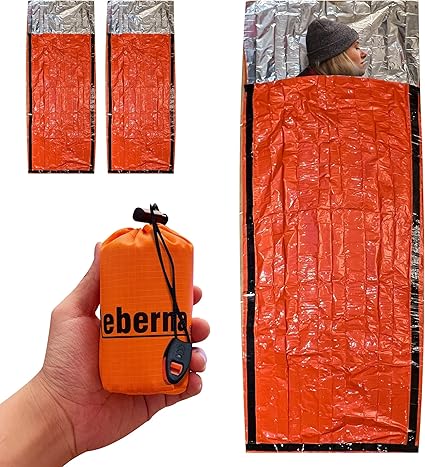
Short Verdict: A highly practical two-pack that makes it easy to equip multiple vehicles or backpacks without spending much. Best For: Families building out winter emergency kits for daily commuter cars. Skip It If: You plan to use it repeatedly; these are strictly for one-time emergency deployment. What Buyers May Regret: Repacking these bags into their tiny stuff sacks after opening them to test them is notoriously frustrating.
Complaint/Watch-Out Pattern: While buyers appreciate the low price and life-saving potential in freezing conditions, the primary recurring complaint is structural durability. Several users report that the seams can split if you toss and turn heavily inside the bag.
User Feedback Summary:
| Signal | Read |
|---|---|
| Pros signal | Strong buyer signal - 4.6/5 across 2,625 Amazon ratings. |
| Evidence depth | Strong evidence - Strong sample size for recurring praise and complaint patterns. |
| Complaint pressure | Very low complaint pressure - No clear recurring complaint theme surfaced in the customer-summary data. |
| Price tier | $ / Budget-friendly; exact Amazon prices change frequently. |
Pros:
- 84-inch length covers tall users
- High-visibility reflective material
- Two bags in one package
- Excellent for glovebox storage
Cons:
- Seams are prone to splitting under stress
- Practically impossible to factory-fold after use
Expert Tip: Never open these just to look at them unless you are prepared to store them loosely in a larger ziplock bag afterward.
Sierra Madre Emergency Sleeping Bag

Short Verdict: An ultralight 6-ounce insurance policy that disappears into your daypack until bad weather strikes. Best For: Minimalist hikers who want emergency protection without adding bulk to their loadout. Skip It If: You anticipate high winds without a secondary shelter; the thin material is loud and can rip if aggressively battered. What Buyers May Regret: The noise. Like all mylar bags, it crinkles loudly with every movement, which can make sleeping difficult even when you are warm.
Complaint/Watch-Out Pattern: Feedback points to successful heat retention, often surprising buyers with how warm it gets inside. However, the recurring watch-out involves the material’s fragility—a few users experienced tears simply from shifting their weight on uneven ground.
User Feedback Summary:
| Signal | Read |
|---|---|
| Pros signal | Strong buyer signal - 4.7/5 across 633 Amazon ratings. |
| Evidence depth | Moderate evidence - Moderate sample size; useful but not exhaustive. |
| Complaint pressure | Very low complaint pressure - No clear recurring complaint theme surfaced in the customer-summary data. |
| Price tier | $ / Budget-friendly; exact Amazon prices change frequently. |
Pros:
- Weighs only 6 ounces
- Windproof and waterproof shield
- Small packed footprint
- Fast deployment
Cons:
- Very noisy material
- Tears easily if snagged
Expert Tip: Pair this with thick socks and a beanie. Keeping your extremities warm will maximize the ambient heat this bag reflects back to your core.
Esky Emergency Sleeping Bag with Compass

Short Verdict: A solid, low-cost thermal shelter that throws in a compass, though the quality of the shelter heavily outweighs the quality of the accessory. Best For: Beginner outdoor kits where low-cost, multi-function gear is a priority. Skip It If: You are relying on the included compass for serious backcountry navigation. What Buyers May Regret: Trusting the bundled compass. It is a novelty add-on and should not replace a dedicated, high-quality navigation tool.
Complaint/Watch-Out Pattern: Buyers love the blanket itself, noting it successfully keeps the chill off in 50-degree weather. However, the compass receives heavily mixed feedback, with multiple reports stating it sticks or points incorrectly. The bag itself also draws some durability concerns regarding rips.
User Feedback Summary:
| Signal | Read |
|---|---|
| Pros signal | Strong buyer signal - 4.6/5 across 2,357 Amazon ratings. |
| Evidence depth | Strong evidence - Strong sample size for recurring praise and complaint patterns. |
| Complaint pressure | Very low complaint pressure - No clear recurring complaint theme surfaced in the customer-summary data. |
| Price tier | $ / Budget-friendly; exact Amazon prices change frequently. |
Pros:
- Effective heat retention
- Packs down incredibly small
- Good value for the shelter material
- Bright visibility for rescue
Cons:
- Compass is often inaccurate
- Material is susceptible to punctures
Expert Tip: Use the bag as a bright signaling device in the event of an emergency; the shiny surface reflects sunlight well during the day.
Life Bivy Sack Waterproof Mylar

Short Verdict: A standard-sized, dependable 84-inch mylar sack that provides full-body coverage for most adults during sudden temperature drops. Best For: Stashing in a bug-out bag or keeping under a car seat for winter breakdowns. Skip It If: You need a breathable layer; this is entirely non-porous. What Buyers May Regret: The immediate sweat buildup. If you run hot or fail to vent the opening, the inside of this bag will become damp quickly.
Complaint/Watch-Out Pattern: Customers confirm this bag fits adults over six feet tall comfortably. The dominant complaint pattern revolves around the fragility of the mylar foil—pulling it too hard when getting in or out frequently leads to seam failures or outright rips.
User Feedback Summary:
| Signal | Read |
|---|---|
| Pros signal | Strong buyer signal - 4.6/5 across 1,150 Amazon ratings. |
| Evidence depth | Strong evidence - Strong sample size for recurring praise and complaint patterns. |
| Complaint pressure | Very low complaint pressure - No clear recurring complaint theme surfaced in the customer-summary data. |
| Price tier | $ / Budget-friendly; exact Amazon prices change frequently. |
Pros:
- 84-inch length accommodates tall users
- Blocks wind effectively
- Very lightweight
- Affordable emergency backup
Cons:
- Traps moisture and causes heavy condensation
- Tears easily under tension
Expert Tip: If you are forced to use this, try to put a layer of pine needles or leaves underneath it (if safe and dry) to pad the thin material against sharp ground debris.
Cymuber Portable Thermal Bivy Sack

Short Verdict: An all-in-one emergency attachment that clips right onto your pack, keeping a shelter and a signaling whistle easily accessible. Best For: Day hikers who want their emergency gear clipped outside their pack for instant access. Skip It If: You want a silent, stealthy camp setup. The bright colors and crinkly material are loud and visible. What Buyers May Regret: The tight dimensions if you are wearing bulky layers. Standard 36-inch width can feel claustrophobic.
Complaint/Watch-Out Pattern: Buyer sentiment is largely positive regarding the value and peace of mind this adds to a kit. The main watch-out is the familiar condensation issue inherent to all mylar, alongside some users finding the carabiner to be flimsy.
User Feedback Summary:
| Signal | Read |
|---|---|
| Pros signal | Strong buyer signal - 4.6/5 across 526 Amazon ratings. |
| Evidence depth | Moderate evidence - Moderate sample size; useful but not exhaustive. |
| Complaint pressure | Very low complaint pressure - No clear recurring complaint theme surfaced in the customer-summary data. |
| Price tier | $ / Budget-friendly; exact Amazon prices change frequently. |
Pros:
- Includes a whistle for signaling
- Carabiner allows easy pack attachment
- Highly compact storage size
- Strong initial seams
Cons:
- Included carabiner is low quality
- Condensation builds up fast
Expert Tip: Keep the whistle attached to the stuff sack string so it doesn’t get lost in the dark if you have to deploy the bag at night.
Wallaby 2-Pack Emergency Mylar Sleeping Bags

Short Verdict: A thoughtful survival package that provides two reliable mylar bags, whistles, paracord, and a mini survival guide in one bundle. Best For: Off-grid explorers and overlanders looking to build out a robust, multi-person emergency kit quickly. Skip It If: You only need a bare-bones shelter and don’t want to pay for extra accessories. What Buyers May Regret: The incredibly tight storage pouches. Getting the bags out is easy; getting them back in is a test of patience.
Complaint/Watch-Out Pattern: Reviewers successfully used these in winter conditions and noted they are surprisingly tough for the price. However, the pattern of complaints strictly highlights how easily the bags can puncture if used on bare, rocky soil, and how hard they are to repack.
User Feedback Summary:
| Signal | Read |
|---|---|
| Pros signal | Strong buyer signal - 4.8/5 across 63 Amazon ratings. |
| Evidence depth | Thin evidence - Thin sample size; watch for pattern changes over time. |
| Complaint pressure | Very low complaint pressure - No clear recurring complaint theme surfaced in the customer-summary data. |
| Price tier | $ / Budget-friendly; exact Amazon prices change frequently. |
Pros:
- Paracord included for rigging improvised shelters
- Integrated whistle pulls
- Pocket survival guide adds value
- Two bags for partner hiking
Cons:
- Nylon pouches are too tight for easy repacking
- Material still vulnerable to sharp sticks
Expert Tip: You can use the included paracord to tie off the foot-end of the bag to a low branch, keeping the material off your legs and managing some condensation.
Emergency Sleeping Bag Portable Thermal Bivy

Short Verdict: A standard, budget-tier thermal bivy that includes a compass, sharing the same basic materials as its competitors but lacking verified long-term buyer feedback. Best For: Throwing into a secondary kit or a guest’s hiking bag as a cheap backup. Skip It If: You prefer gear that has been heavily vetted by hundreds of trail-tested reviews. What Buyers May Regret: Purchasing this solely for the compass, which is likely a generic add-on with questionable magnetic reliability.
Complaint/Watch-Out Pattern: Because this specific listing lacks a high volume of reviews, we must infer performance based on identical mylar construction. Expect the standard pitfalls: it will keep you warm by reflecting heat, but it will trap sweat and tear if abused on rough ground.
User Feedback Summary:
| Signal | Read |
|---|---|
| Pros signal | Moderate buyer signal - No reliable aggregate rating was available in the scraped product data. |
| Evidence depth | Limited evidence - Thin sample size; watch for pattern changes over time. |
| Complaint pressure | Moderate complaint pressure - No clear customer-summary complaint signal was available. |
| Price tier | Price varies; exact Amazon prices change frequently. |
Pros:
- Standard heat-reflective lining
- Lightweight and highly portable
- High-visibility exterior
Cons:
- No verified long-term durability data
- Bundled compasses are rarely accurate
Expert Tip: Before trusting this on a remote trip, unroll it in your living room to check for manufacturing defects along the side seams.
84"x36" Thermal Mylar Bivy Sack

Short Verdict: A reliable, no-nonsense polyethylene and mylar blend that excels at blocking harsh winds and retaining core body heat. Best For: Storing in a winter car kit or taking on late-fall hiking trips where sudden snow is a risk. Skip It If: You toss and turn heavily in your sleep, as the narrow 36-inch width restricts movement. What Buyers May Regret: Thinking this is a substitute for a real sleeping bag. It has no insulation of its own and relies entirely on your body heat.
Complaint/Watch-Out Pattern: Customers praise the fast shipping and the compact nature of the bag. The standard complaint applies: it is very difficult to fold back into a manageable size once the factory seal is broken.
User Feedback Summary:
| Signal | Read |
|---|---|
| Pros signal | Strong buyer signal - 4.7/5 across 689 Amazon ratings. |
| Evidence depth | Moderate evidence - Moderate sample size; useful but not exhaustive. |
| Complaint pressure | Very low complaint pressure - No clear recurring complaint theme surfaced in the customer-summary data. |
| Price tier | $ / Budget-friendly; exact Amazon prices change frequently. |
Pros:
- Polyethylene construction helps block wind
- Fits into glove compartments easily
- Reflects heat very effectively
- Affordable
Cons:
- Tight 36-inch width restricts mobility
- Single-use practicality due to repacking difficulty
Expert Tip: If you are stuck in a cold car during a breakdown, use this inside the cabin. It will reflect your heat much faster than the car’s interior fabric.
Survive Outdoors Longer (SOL) 90% Emergency Bivvy

Short Verdict: A step up in quality from generic mylar bags, offering slightly better durability and smart survival features like a tinder paracord drawstring. Best For: Serious backcountry hikers who want name-brand reliability in their survival kit. Skip It If: You are on a strict budget and just want the cheapest possible reflective blanket. What Buyers May Regret: The price point is slightly higher for a single bag compared to multi-packs of generic alternatives.
Complaint/Watch-Out Pattern: Users appreciate the form factor (about the size of a soda can) and note that it is genuinely possible to stuff this back into its bag, unlike cheaper models. However, buyers still caution that the material is thin and will puncture if placed on thorns or sharp rocks.
User Feedback Summary:
| Signal | Read |
|---|---|
| Pros signal | Strong buyer signal - 4.7/5 across 414 Amazon ratings. |
| Evidence depth | Moderate evidence - Moderate sample size; useful but not exhaustive. |
| Complaint pressure | Very low complaint pressure - No clear recurring complaint theme surfaced in the customer-summary data. |
| Price tier | $ / Budget-friendly; exact Amazon prices change frequently. |
Pros:
- Drawstring is made of usable tinder paracord
- Includes a functional survival whistle
- Slightly easier to repack than budget options
- Weighs under 4 ounces
Cons:
- Higher cost per unit
- Still requires care to prevent punctures
Expert Tip: If you need to start a fire in an emergency, trim a small piece off the outer sheath of the stuff sack’s drawstring to access the flammable tinder core.
Final Summary
Selecting the right emergency bivy sack comes down to how and where you plan to store it. If you want a reliable backup for your backcountry daypack, the Survive Outdoors Longer (SOL) Bivvy offers clever survival features and a slightly better stuff-sack design. If you are outfitting multiple vehicles for winter road trips, the Leberna 2 Pack provides the best cost-to-coverage ratio. For hikers with broad shoulders who find standard bags too restrictive, the 47-inch wide Emergency Sleeping Bag Survival Bag offers the extra room needed to keep seams from splitting under pressure. Remember to manage condensation by venting the bag, and pair these shelters with appropriate seasonal clothing for the best results.