Trying to cram a fluffy, zero-degree sleeping bag into the bottom of a hiking backpack is a quick way to ruin your morning pack-out routine. A well-built compression sack solves the packed size problem, shrinking your bulky sleep gear down to a hard, manageable melon. However, a cheap compression sack is just a ticking time bomb of weak stitching and brittle plastic that will inevitably snap while you are pulling the straps tight miles from the trailhead.
Choosing the right sack is about balancing weight and mechanical strength. When you aggressively tighten compression straps, all that pressure transfers directly to the seams. If you are investing in protecting the warmth of your sleeping bag , you need a stuff sack that won’t rip at the anchor points or allow moisture to seep through when you set your pack on wet grass.
It is easy to assume all stuff sacks are identical, but fabric weights range from ultralight 20-denier nylon that requires careful handling to rugged 70-denier materials built for heavy abuse. Building a reliable camp sleep system means finding the right fit for your specific gear—whether you are packing down bulky camping blankets , pairing with self-inflating sleeping mats , or just trying to free up enough backpack space for empty fuel bottles and fire starters in your camp kitchen kit.
How We Read This List
To help you avoid gear failures in the backcountry, we analyzed product specifications, fabric denier ratings, buckle designs, and long-term customer feedback signals. No hands-on field testing was conducted for this guide. Instead, we evaluated these products based on reported marketplace data, focusing heavily on stitching durability, strap reliability, and how well the stated dimensions hold up to real-world bulky items. We prioritize consistent performance over marketing claims, paying special attention to buyer reports of torn seams and snapped buckles.
Buying Scope and Fit Notes
This guide is intentionally narrow: it covers Compression Sacks inside Sleeping Bags & Camp Bedding > Sleeping Bag Accessories. The comparison uses a marketplace best-seller snapshot, product listing details, price-tier signals, and repeated buyer-feedback patterns rather than brand copy alone. It is most useful when you are comparing best compression sacks, compression sacks buying guide, compression sacks reviews, compression sacks for camping and hiking; if you need a broader setup, start from the nearest category hub before picking a single product.
Quick Picks
- Best for Reliable Durability: Sea to Summit Lightweight Compression Sack
- Best for Military-Style Organization: M-Tac Compression Stuff Sack
- Best for Massive Sleeping Bags: GoldCamp Outdoor Storage Stuff Sacks
- Best Budget Option for Roll-Top Protection: NewShot Ultralight Portable Compression Sack
- Best for High-Volume Family Camping: Frelaxy Compression Sack
Buying Guide
Will a compression sack ruin sleeping bag warmth?
Yes, if you use it wrong. Leaving a down or synthetic sleeping bag fully compressed for weeks or months in your closet will crush the insulation. When the insulation loses its ability to expand (its loft), the bag loses its warmth and camping comfort. Only use a compression sack while actively traveling to and from your campsite. When you get home, store your bag in a large, breathable cotton storage sack or hang it loosely in a closet.
How much packed size do you actually save?
A good compression sack typically reduces the packed size of a soft item by 30% to 50%. However, this puts immense tension on the bag’s fabric. If a manufacturer uses cheap single stitching where the straps meet the bag, the compression force will rip the straps right out of the nylon. When buying budget options, pull the straps evenly rather than yanking hard on one side at a time.
Which fabric weight makes sense for your trip?
Ultralight backpackers often lean toward 20D or 40D nylon to shave ounces, but these fabrics require gentle handling and snag easily on stray branches or sharp gear inside your pack. If you are an overlander, car camper, or someone who treats gear rough, skip the ultralight materials and look for 70D nylon or 210T polyester. The slight increase in weight translates directly to a longer lifespan and fewer blown seams.
Common Questions Before Buying
What should I check before buying compression sacks?
Start with warmth, comfort, packed size, support, setup time, cleaning, and likely comfort tradeoffs. Then check whether the product matches your trip length, weather, group size, and storage limits.
How do I avoid regretting sleep gear?
Match the item to your sleep style, expected temperature, packed-space limits, and whether you are car camping or carrying it on trail.
What sleep gear details matter after the first night?
Noise, zipper feel, width, support, inflation or setup effort, and how easily the item dries or cleans can matter more than headline claims.
Related Resources
Internal Gear Guides
- Best Blankets of 2026 for Camping Sleep Comfort and Packability - Use this to compare nearby sleeping bags & camp bedding tradeoffs before you buy.
- Best Self-Inflating Sleeping Mats of 2026: Buyer Cautions - Use this to compare nearby sleeping bags & camp bedding tradeoffs before you buy.
- Best Sleeping Bags of 2026 for Camping Comfort and Cold Nights - Use this to compare nearby sleeping bags & camp bedding tradeoffs before you buy.
- Best Backpack Rain Covers of 2026 for Hiking and Wet Weather - Use this to compare nearby packs and storage tradeoffs before you buy.
External References
- REI Expert Advice on the Ten Essentials - Practical checklist context for packing and evaluating outdoor gear systems.
- Leave No Trace Seven Principles - Low-impact camping guidance for campsites, cooking, waste, fires, and shared outdoor spaces.
Comparison Table
| Product | Best For | Standout Upside | Buyer Caution | Skip-If |
|---|---|---|---|---|
| Sea to Summit Lightweight | Backpacking and travel | Flip-top lid prevents tangled straps | Higher price point | You just need a cheap bag for seasonal closet storage |
| M-Tac Compression Sack | Tactical gear and rough handling | Horizontal and vertical compression | Heavy compared to ultralight bags | You are counting every gram in your pack |
| GoldCamp XXXL Sack | Massive zero-degree bags | Fits oversized, bulky items easily | May be too wide for smaller backpacks | You use a standard summer-weight bag |
| NewShot Roll-Top Sack | Wet weather hiking | Roll-top closure keeps drips out | Sizing runs small for some buyers | You prefer traditional drawstring tops |
| Generic 12L-53L Sack (B0CL792WN6) | Family campers on a budget | Wide range of size options | Thin 20D/40D nylon requires gentle use | You have a habit of yanking straps aggressively |
| Hikenture Compression Sack | Ultralight weekend trips | Very low weight | Side-release buckles can be brittle | You pack heavy synthetic winter bags |
| HIKEMAN Compression Sack | Double sleeping bags or quilts | High-capacity sizing | Mixed durability reports over time | You need proven expedition reliability |
| REDCAMP Nylon Sack | General car camping | Ripstop fabric resists minor tearing | Prone to seam failure under high tension | You need waterproof marine protection |
| Frelaxy Compression Sack | Stuffing kids’ sleeping bags | Easy sizing for fluffy bedding | Buckles can slip under pressure | You want straps that stay locked tight all day |
| Standard Unbranded Sack | Emergency backup | Basic functional placeholder | Complete lack of marketplace durability data | You need guaranteed trail performance |
Deep Reviews
Generic 12L-53L Water-Resistant Sleeping Bag Stuff Sack

Short Verdict: A budget-friendly, ultralight option that offers significant space savings but requires gentle handling to avoid strap failure. Best For: Casual hikers and family campers needing to organize multiple bags without adding weight. Skip It If: You pull straps aggressively or use stiff, heavy synthetic winter bags. What Buyers May Regret: The combination of 20D nylon body and aggressive compression can lead to premature tearing if overstuffed.
User Feedback Summary:
| Signal | Read |
|---|---|
| Pros signal | Moderate buyer signal - 4.4/5 across 347 Amazon ratings. |
| Evidence depth | Moderate evidence - Moderate sample size; useful but not exhaustive. |
| Complaint pressure | Low complaint pressure - No clear recurring complaint theme surfaced in the customer-summary data. |
| Price tier | $ / Budget-friendly; exact Amazon prices change frequently. |
Complaint/Watch-out pattern: Customer-summary signals point to a recurring issue with the straps and buckles. Several users report that the plastic buckles snap or the straps rip away from the bag during the very first use when significant tension is applied.
Pros:
- Very lightweight 20D/40D nylon construction
- Available in multiple sizes up to 53L
- Good for compressing large down comforters
Cons:
- Straps are prone to breaking under heavy loads
- Material feels thin and fragile to some users
- Hardware durability is questionable
Expert Tip: To prevent the straps from tearing out, sit or kneel on your sleeping bag to compress the air out before tightening the straps. Check Price on Amazon
Hikenture Compression Sack for Sleeping Bag

Short Verdict: An upgraded 40D nylon sack that balances low weight with slight tear resistance, though the plastic hardware remains a weak point. Best For: Backpackers trying to squeeze a summer sleeping bag into a smaller pack compartment. Skip It If: You have a bulky winter bag that requires extreme compression force to fit in your pack. What Buyers May Regret: The sizing tends to run smaller than advertised, making it frustrating to stuff wider bags inside.
User Feedback Summary:
| Signal | Read |
|---|---|
| Pros signal | Moderate buyer signal - 4.4/5 across 1,712 Amazon ratings. |
| Evidence depth | Strong evidence - Strong sample size for recurring praise and complaint patterns. |
| Complaint pressure | Low complaint pressure - No clear recurring complaint theme surfaced in the customer-summary data. |
| Price tier | $ / Budget-friendly; exact Amazon prices change frequently. |
Complaint/Watch-out pattern: The most consistent buyer warning involves the side release buckles. While the fabric is an upgraded 40D nylon, users frequently report the plastic buckles breaking easily when attempting to squeeze out the last bit of space.
Pros:
- 40D nylon offers a decent weight-to-durability ratio
- Two side release buckles for easier access
- Water-resistant coating helps deflect light moisture
Cons:
- Buckles fail easily under tension
- Sizing feels smaller than the stated capacity
- Stitching may arrive with defects
Expert Tip: Treat the side release buckles as closure mechanisms, not as levers to pull down on. Pull the webbing strap directly to tighten. Check Price on Amazon
M-Tac Compression Stuff Sack for Sleeping Bag

Short Verdict: A sturdy, military-style compression sack that prioritizes tough stitching and solid materials over ultralight specs. Best For: Overlanders, hunters, and campers who need gear that can survive being tossed around in the dirt. Skip It If: You are an ultralight hiker trying to shave every possible ounce off your base weight. What Buyers May Regret: The cylindrical shape and thick fabric can make the final compressed shape slightly awkward to pack alongside softer gear.
User Feedback Summary:
| Signal | Read |
|---|---|
| Pros signal | Strong buyer signal - 4.6/5 across 2,971 Amazon ratings. |
| Evidence depth | Strong evidence - Strong sample size for recurring praise and complaint patterns. |
| Complaint pressure | Very low complaint pressure - No clear recurring complaint theme surfaced in the customer-summary data. |
| Price tier | $ / Budget-friendly; exact Amazon prices change frequently. |
Complaint/Watch-out pattern: Most complaints focus on the overall dimensions rather than failures. Buyers note that the sack runs relatively small, making it difficult to fit thick extreme-cold-weather sleep systems despite the sturdy straps.
Pros:
- Extremely durable stitching designed for rough use
- Compresses in both horizontal and vertical directions
- Slings and straps are thick enough to pull down hard on
Cons:
- Heavier than standard nylon options
- Sizing may be too small for large winter bags
- Less malleable when fully compressed
Expert Tip: The horizontal compression straps on this model allow you to shape the bag into a cylinder, which fits perfectly at the bottom of external frame packs. Check Price on Amazon
NewShot Ultralight Portable Compression Sack

Short Verdict: A roll-top alternative to standard drawstring sacks that offers better protection against rainwater and moisture. Best For: Backpackers expecting wet weather who need to ensure no water drips into the top opening of their stuff sack. Skip It If: You dislike the extra steps required to roll and buckle the top before compressing. What Buyers May Regret: Some buyers feel the capacity is restricted by the roll-top design, leaving less usable interior volume than a standard 15L or 27L bag.
User Feedback Summary:
| Signal | Read |
|---|---|
| Pros signal | Moderate buyer signal - 4.2/5 across 44 Amazon ratings. |
| Evidence depth | Limited evidence - Thin sample size; watch for pattern changes over time. |
| Complaint pressure | Elevated complaint pressure - However, the size receives mixed feedback, with some finding it perfect while others say it’s bit small. |
| Price tier | $ / Budget-friendly; exact Amazon prices change frequently. |
Complaint/Watch-out pattern: The primary watch-out is the premium price on this specific marketplace listing compared to direct manufacturer sites, alongside reports that the bag feels smaller than the listed liter capacity once rolled closed.
Pros:
- Roll-top design effectively seals out dripping water
- Bottom and top handles make it easy to carry or pull out of a pack
- Lightweight nylon construction
Cons:
- Roll-top eats into the usable volume
- Premium marketplace pricing
- Sizing runs a bit small
Expert Tip: Roll the top down at least three times to ensure the opening is sealed off from ambient campsite moisture before buckling. Check Price on Amazon
Sea to Summit Lightweight Compression Sack

Short Verdict: A reliable, well-engineered compression sack built with 70D PU-coated nylon that justifies its mid-range price tag. Best For: Frequent backpackers and travelers who need long-term durability and tangle-free straps. Skip It If: You only camp once a year and don’t want to spend extra on premium accessories. What Buyers May Regret: The white interior coating, designed to make finding gear easier, can show dirt quickly if you stuff damp or dusty items inside.
User Feedback Summary:
| Signal | Read |
|---|---|
| Pros signal | Strong buyer signal - 4.7/5 across 123 Amazon ratings. |
| Evidence depth | Thin evidence - Thin sample size; watch for pattern changes over time. |
| Complaint pressure | Very low complaint pressure - No clear recurring complaint theme surfaced in the customer-summary data. |
| Price tier | $$ / Mid-range; exact Amazon prices change frequently. |
Complaint/Watch-out pattern: Negative feedback is rare, though some buyers mention it isn’t ideal for storing loose, oddly shaped items like dirty laundry, as the compression lid works best against a single solid mass like a sleeping bag.
Pros:
- 70D PU-coated nylon is highly durable and tear-resistant
- Flip-top lid prevents the straps from turning into a tangled mess
- Double-stitched seams handle high tension well
Cons:
- Mid-range price tier
- Not ideal for loose, small items
- Interior white coating gets dirty fast
Expert Tip: Use the reinforced webbing pull handle on the round base to easily extract the tightly packed sack from the bottom of a deep hiking backpack. Check Price on Amazon
HIKEMAN Compression Sack
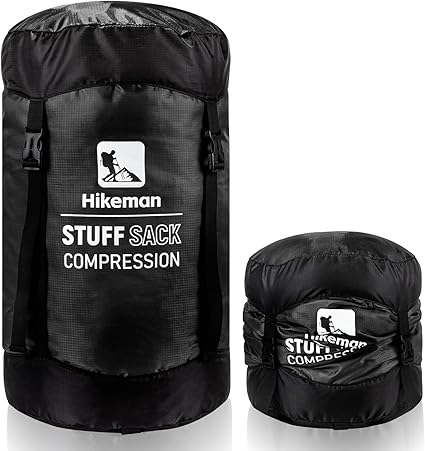
Short Verdict: A high-capacity, budget-friendly sack made of 210T polyester that is excellent for large, double-wide bags or thick quilts. Best For: Car campers who bring thick, household-style blankets or queen-sized camping quilts. Skip It If: You require reliable compression for long, rugged backpacking routes. What Buyers May Regret: The durability is inconsistent, meaning you might get a great bag, or you might get one that tears under mild pressure.
User Feedback Summary:
| Signal | Read |
|---|---|
| Pros signal | Strong buyer signal - 4.6/5 across 61 Amazon ratings. |
| Evidence depth | Thin evidence - Thin sample size; watch for pattern changes over time. |
| Complaint pressure | Very low complaint pressure - No clear recurring complaint theme surfaced in the customer-summary data. |
| Price tier | $ / Budget-friendly; exact Amazon prices change frequently. |
Complaint/Watch-out pattern: Customer reviews show a split in durability experiences. While many successfully compress massive bags, a notable pattern of buyers report the 210T polyester tearing or seams failing after only a few uses.
Pros:
- Excellent sizes available for huge sleep systems
- 210T polyester balances weight and cost
- Includes quick-release buckle straps
Cons:
- Hit-or-miss long term durability
- Seams may fail on heavier quilts
- Sizing might be wider than a standard backpack compartment
Expert Tip: If you are packing a massive double sleeping bag, enlist a friend to help push the bag down into the sack while you gently cinch the straps to reduce seam strain. Check Price on Amazon
REDCAMP Nylon Compression Stuff Sack

Short Verdict: A highly popular, affordable ripstop nylon sack that works well for basic, moderate compression needs. Best For: Beginner backpackers and casual campers who need an affordable upgrade from the flimsy sack their sleeping bag came with. Skip It If: You aggressively crank down your compression straps to create the smallest possible package. What Buyers May Regret: Because it’s lightweight ripstop, trying to force a bag into a sack that is one size too small will likely result in ripped fabric.
User Feedback Summary:
| Signal | Read |
|---|---|
| Pros signal | Moderate buyer signal - 4.4/5 across 4,386 Amazon ratings. |
| Evidence depth | Strong evidence - Strong sample size for recurring praise and complaint patterns. |
| Complaint pressure | Low complaint pressure - No clear recurring complaint theme surfaced in the customer-summary data. |
| Price tier | $ / Budget-friendly; exact Amazon prices change frequently. |
Complaint/Watch-out pattern: A frequent complaint involves the fabric tearing away from the compression straps. Buyers note that the bag performs well for a few trips but can suddenly rip near the top rim if subjected to heavy pulling.
Pros:
- Very affordable budget option
- Ripstop fabric helps stop small punctures from spreading
- Good medium sizing for standard adult sleeping bags
Cons:
- Straps tear away from the fabric under heavy stress
- Not meant for extreme compression
- Hardware feels cheap
Expert Tip: Always err on the side of buying one size larger than you think you need. A slightly loose compression sack is much less likely to blow out its seams. Check Price on Amazon
GoldCamp Outdoor Storage Stuff Sacks (XXXL)

Short Verdict: A heavy-duty, massive storage option with a roll-top closure, built to swallow the largest 0-degree winter bags on the market. Best For: Winter campers and overlanders who use massive, canvas-style sleeping bags that refuse to fit in standard sacks. Skip It If: You only use standard summer bags or need something that fits inside a narrow 50L hiking pack. What Buyers May Regret: The XXXL size creates a packed shape that is often too wide to fit horizontally inside standard internal frame backpacks.
User Feedback Summary:
| Signal | Read |
|---|---|
| Pros signal | Strong buyer signal - 4.5/5 across 77 Amazon ratings. |
| Evidence depth | Thin evidence - Thin sample size; watch for pattern changes over time. |
| Complaint pressure | Low complaint pressure - No clear recurring complaint theme surfaced in the customer-summary data. |
| Price tier | $ / Budget-friendly; exact Amazon prices change frequently. |
Complaint/Watch-out pattern: The main watch-out is the sheer physical size of the bag when filled. While it easily holds bulky gear, buyers often realize too late that the resulting package is too large for anything but a car trunk or a massive expedition pack.
Pros:
- Easily accommodates giant 0-degree bags
- Roll-top closure system keeps gear secure and dry
- Rugged ripstop material resists abrasion
Cons:
- XXXL size is too wide for most standard backpacks
- Too bulky for light summer sleeping bags
- Straps can be unwieldy when fully extended
Expert Tip: Use this sack as a general gear organizer in your trunk to hold loose blankets, camp pillows, and jackets, compressing them all into one manageable block. Check Price on Amazon
Frelaxy Compression Sack

Short Verdict: A highly rated, versatile bag that makes stuffing kids’ bags and fluffy bedding easy, though the buckles occasionally slip. Best For: Parents trying to manage multiple kids’ sleeping bags or campers who prefer slightly wider sack openings. Skip It If: You need your gear to stay locked down tightly without ever slipping during a rough hike. What Buyers May Regret: The plastic webbing slides lack friction, meaning the straps may slowly loosen themselves as your pack bounces down the trail.
User Feedback Summary:
| Signal | Read |
|---|---|
| Pros signal | Strong buyer signal - 4.5/5 across 6,397 Amazon ratings. |
| Evidence depth | Very strong evidence - Very strong sample size for marketplace pattern reading. |
| Complaint pressure | Low complaint pressure - No clear recurring complaint theme surfaced in the customer-summary data. |
| Price tier | $ / Budget-friendly; exact Amazon prices change frequently. |
Complaint/Watch-out pattern: The primary functional complaint is that the buckles and webbing are too slippery. Buyers report that after fully compressing the bag, the straps slowly slide back through the plastic hardware, causing the sack to expand.
Pros:
- Wide opening makes it easy to stuff large bags
- Very affordable across multiple sizes
- Lightweight and highly compressible
Cons:
- Straps tend to slip through the buckles
- Immediate rips reported by some users
- Hardware lacks gripping teeth
Expert Tip: After tightening the straps to your desired size, tie a simple half-hitch knot with the excess webbing directly behind the buckle to prevent the strap from slipping backward. Check Price on Amazon
Standard Unbranded Compression Sack
Short Verdict: A placeholder listing for a generic compression sack lacking verifiable marketplace data, making it impossible to recommend for serious outdoor use. Best For: Emergency, disposable use where long-term durability is entirely irrelevant. Skip It If: You need to trust your gear on the trail or want proven customer feedback before spending your money. What Buyers May Regret: Purchasing gear without verifiable reviews or materials specs often results in immediate seam failures on the first trip.
Complaint/Watch-out pattern: Marketplace details and customer signals are currently unavailable for this specific listing (B08GFVJLL4). Without a proven track record, unbranded compression gear almost always suffers from weak, single-stitched seams that fail under the tension of a sleeping bag.
Pros:
- Basic functional design (assumed)
- Likely available at a highly discounted price
Cons:
- Zero verifiable customer durability data
- No listed material specs (denier or fabric type)
- High risk of immediate strap failure
Expert Tip: If you end up with an unbranded, mystery-fabric stuff sack, only use it for soft clothing organization inside your pack, and never use it to heavily compress a stiff sleeping bag.
Final Summary
Finding the right compression sack comes down to matching your trip’s physical demands to the fabric’s strength. If you are packing for a rugged, multi-day backpacking trip, investing in the 70D nylon construction of the Sea to Summit Lightweight sack will save you the headache of a blown-out seam miles from civilization. For car campers or overlanders dealing with oversized zero-degree bags, the massive capacity of the GoldCamp XXXL or H